If you’ve got a Shopify store with 50+ products that need descriptions, writing them one by one is a time sink. An AI product description generator can help — but the quality gap between apps is massive, especially if you care about brand consistency, SEO, or bulk generation speed.
I tested six tools this year: Ritely, Profitonium, Avada SEO On, Youssify, Shopify Magic, and ChatGPT. For a deeper look at how these tools work under the hood, see our merchant’s guide to AI product descriptions.
Here’s what each one does well — and where it falls short.
Ritely
Ritely is newer (launched in 2026) and Claude-powered. It’s designed for merchants who want actual brand voice, not just generic AI copy.
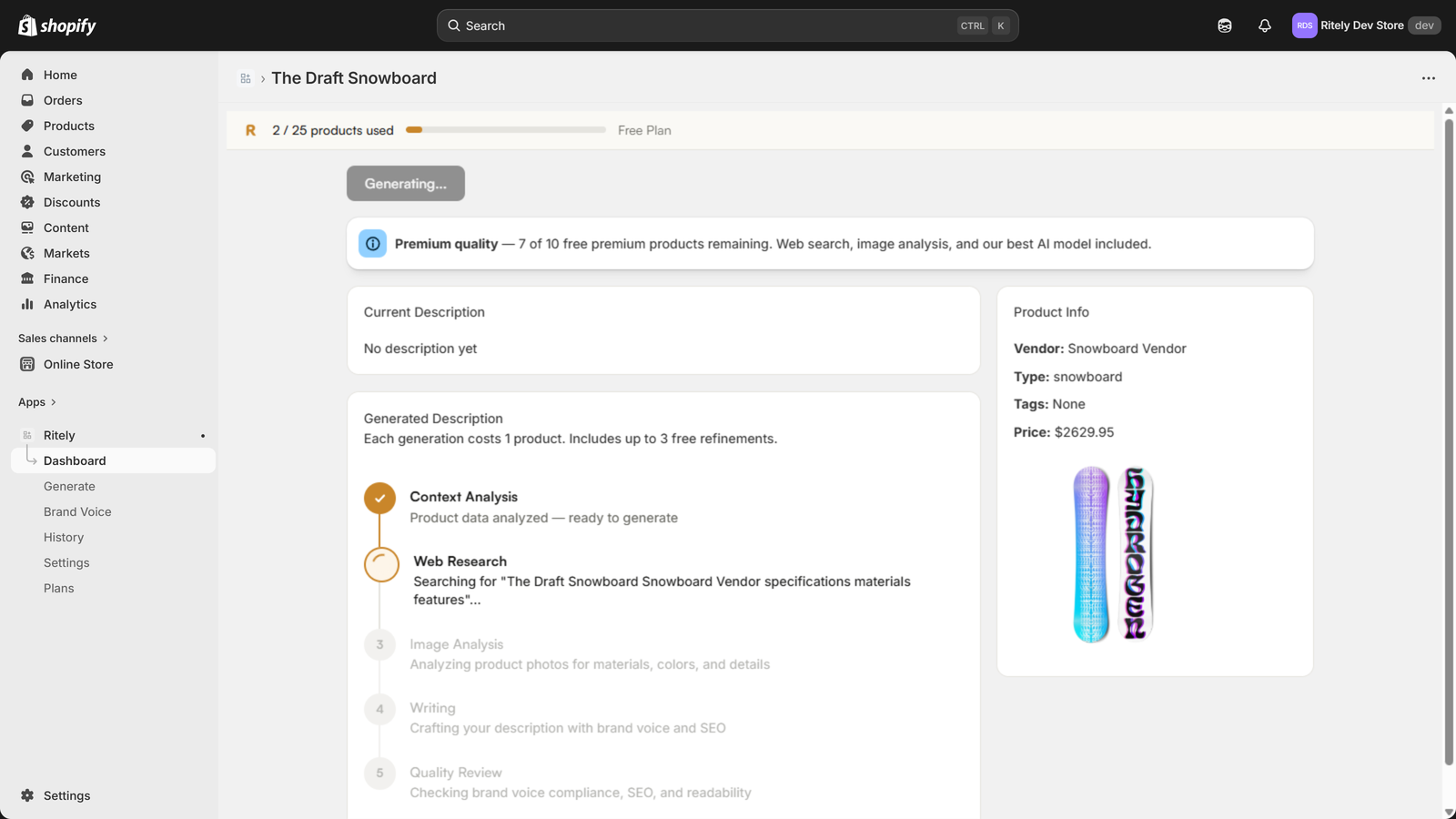

How it works: You build a brand voice profile (materials, questionnaire, or preset). The app then runs a five-step pipeline on each product: assess what you’re selling, research the product category, pull in product images via vision, generate descriptions, and self-review for quality. It learns your brand voice across generations.
What’s good: Brand voice actually sticks. The vision integration means it reads your product photos — useful if your image metadata is thin. Bulk generation with real-time progress. Three free refinement rounds per product if you want tweaks. Free tier covers 25 products per month, which is real value.
Limitations: Newer app, smaller user base, fewer reviews. The agentic pipeline is more compute-heavy than simpler tools, so generation takes longer (usually 30-60 seconds per product). You’re committed to setting up your brand voice first — no shortcuts there.
Pricing: Free ($0, 25 products/mo) / Starter ($14.99/mo, 250) / Growth ($39.99/mo, 1,000) / Scale ($99.99/mo, 5,000). No credit card required for the free tier.
Best for: Merchants with a defined brand voice who want descriptions that actually sound like their store. Sellers who care about SEO and research-backed copy. Bulk operations over 100 products.
See Shopify Magic vs. Ritely for a detailed head-to-head comparison, or read more about building brand voice with AI.
Profitonium (AI Product Descriptions)
Profitonium is the established player. 4.9 stars, 398 reviews. GPT-based (OpenAI backend).
How it works: Feed it your product data (title, category, tags) and it generates descriptions. You can customize tone (professional, casual, funny) and set length preferences. It integrates directly with Shopify’s product editor.
What’s good: Rock-solid track record. Big user base means lots of community feedback and iterations. Simple interface. Works reliably for basic to intermediate use cases. Bulk generation supported.
Limitations: Brand voice is surface-level — you pick from presets, not build a custom profile. Recent updates added image analysis and web search, narrowing the feature gap with newer tools, but the core approach is still prompt-and-generate rather than a multi-step pipeline. Can generate generic copy if your product data is sparse.
Pricing: Freemium model. Free tier is limited; pricing starts at $14.90/mo for the Basic plan, scaling up with volume.
Best for: Merchants who need reliable, quick descriptions without heavy lifting. Sellers comfortable with GPT-style output. Smaller catalogs or supplementary descriptions.
Avada (SEO On)
Avada SEO On positions itself as SEO-first. 4.9 stars, 4,389 reviews. Built for Shopify certified.
How it works: You provide product info and keyword targets. Avada generates descriptions optimized for search ranking, focusing on keyword density and semantic relevance. It includes meta description generation and multilingual support.
What’s good: Strong focus on SEO technical metrics. Handy if you’re chasing specific keywords. Generates both description and meta description at once, saving a step. Decent bulk capability. Free tier is genuinely useful.
Limitations: SEO focus means copy can feel keyword-stuffed or stilted if you’re not careful. Brand voice is minimal. Like other GPT tools, no vision. The SEO angle is useful if you know exactly which keywords to target — if you don’t, you’re guessing.
Pricing: Freemium structure, paid plans from roughly $9.99/mo-$29.99/mo depending on volume.
Best for: SEO-focused merchants who already have keyword research done. Sellers optimizing for specific search terms. Shops where quantity beats brand consistency.
Youssify
A growing competitor. 4.0 stars, 72 reviews. GPT-based bulk description generator with SEO, blog, and multilingual features.
How it works: Analyzes your products and generates descriptions in bulk. Minimal setup — connect your store, select products, and it generates copy. Also handles meta descriptions, blog posts, and multi-language output.
What’s good: Fast bulk generation. Users report writing hundreds of descriptions in hours. Simple onboarding with no heavy setup. Pricing is competitive. Feature set has expanded significantly to include SEO optimization and bulk editing.
Limitations: Reviews are mixed — some merchants report inconsistencies between prompts and output. Rating has dropped from its initial 5.0 as more merchants have tested it at scale.
Pricing: Free tier (100 generations) / Starter $10/mo / Professional $25/mo / Enterprise $35/mo.
Best for: Merchants who need fast bulk generation at a competitive price. Worth testing on a small batch first.
Shopify Magic
Shopify’s built-in AI assistant. Free and baked into the platform. Winter 2026 update added brand-aware tone presets.
How it works: Open any product, click “Draft with AI,” pick a tone (professional, friendly, casual, witty, luxury). It generates description. Simple as that.
What’s good: Free. No app to install, no API setup, no learning curve. Right there in your product editor. Tone presets help steer the output toward your brand (somewhat). Good for testing the idea of AI descriptions without committing to a new tool.
Limitations: One description at a time — no bulk generation. Tone presets are nice but shallow; you can’t build a custom brand voice profile. No vision, no research, no refinement rounds. Often produces generic copy. No integration with external SEO tools. Each time you run it, you might get different results (no consistency). If you want descriptions to sound like your brand, Magic won’t get you there.
Pricing: Free.
Best for: Quick drafts or starting points. Merchants just dipping their toes into AI. Stores with under 50 products. Backup when you need a description today and don’t want to wait.
For more on Magic’s limitations and how dedicated apps compare, see Shopify Magic vs. Ritely.
Using ChatGPT Directly
You can also just use ChatGPT (free or Plus) to write descriptions manually.
How it works: Copy your product data into ChatGPT, ask for a description with your tone, paste the output back into Shopify.
What’s good: Cheap or free (ChatGPT Plus is $20/mo). You can ask follow-up questions and iterate. Works fine for small batches or one-off products.
Limitations: Manual. If you have 100 products, you’ll be switching windows 100 times. No brand voice memory — you have to re-explain your brand in every prompt. No Shopify integration, so no bulk export. Vision works in ChatGPT, but you’re uploading images manually each time. Slow for scale. Each conversation is isolated, so consistency is hard.
Pricing: Free (limited, slower) or $20/mo for ChatGPT Plus.
Best for: Occasional, one-off descriptions. Merchants testing the waters. Small stores with 10-20 products. Content writers who like iterating in natural language. For a deeper analysis of when ChatGPT makes sense vs. a dedicated app, see ChatGPT vs Shopify Apps for Product Descriptions.
Quick Comparison
- Brand voice: Ritely (custom 3-layer), Profitonium/Avada (presets), Shopify Magic (light presets), ChatGPT (manual)
- Bulk generation: Ritely, Profitonium, Avada — all support it. Shopify Magic — one at a time. ChatGPT — manual.
- Vision (reads images): Ritely and Profitonium (among apps). ChatGPT if you upload manually.
- Research: Ritely and Profitonium search the web. Others rely on your product data.
- Price for 1,000 products/mo: Ritely $39.99, Profitonium/Avada ~$20-29, Shopify Magic $0, ChatGPT Plus $20.
- Learning curve: ChatGPT and Shopify Magic (minimal). Ritely (medium — brand voice setup). Profitonium/Avada (minimal).
- Consistency: Ritely (best), Profitonium/Avada (good), Shopify Magic (fair), ChatGPT (manual effort required).
Which One Should You Pick?
You have 50-200 products and want to ship descriptions fast: Start with Shopify Magic (free, instant) or Profitonium (cheap, reliable). If the output feels generic, step up to Ritely to inject actual brand voice.
You have 500+ products and brand consistency matters: Ritely or Profitonium. Ritely if you’ve defined your brand voice; Profitonium if you want speed and don’t need deep customization.
You’re obsessed with SEO rankings: Avada SEO On, but do your keyword research first. Or use any app and optimize titles and meta descriptions separately — many apps don’t nail SEO, so treat it as a bonus if they do. And remember, product descriptions are just one part of the equation. Optimize the entire product page for search: images, alt text, schema markup, and page speed all matter.
You have 10-50 products and time to iterate: ChatGPT Plus. You’ll spend more time writing prompts than using an app, but you’ll get exactly what you want.
You’re evaluating your options: Try Shopify Magic first (free, already available). If it feels too generic, test Ritely’s free tier (25 products/mo) or Profitonium’s free plan. Compare the actual output on your products before paying.
The Bottom Line
There’s no single “best” tool. It depends on your catalog size, budget, brand voice priorities, and how much setup you can tolerate.
If brand consistency and research matter to you, Ritely’s agentic pipeline stands out. If you need proven reliability at a fair price, Profitonium has 398 reviews for a reason. If SEO is your angle, Avada SEO On. If you just need a one-off draft, Shopify Magic is free.
The key: test before you commit. Most of these tools have free tiers or trials. Generate a few descriptions on your actual products and see which output you’d be proud to ship.
For a deeper dive, check out our guide on how to write product descriptions with AI, or read more about building a consistent brand voice.